

Introduction
If you’re planning to build a website in 2026, one question comes up almost immediately:
👉 Should you choose WordPress, Shopify, or Webflow?
Each platform is powerful—but they are built for different purposes.
Choosing the wrong one can lead to:
- limitations later
- higher costs
- unnecessary complexity
So instead of comparing features blindly, let’s break it down the right way—based on real business needs.
⚙️ 1. WordPress — Flexibility & Full Control
WordPress powers over 40% of websites on the internet—and for good reason.
It is the most flexible and scalable platform available.
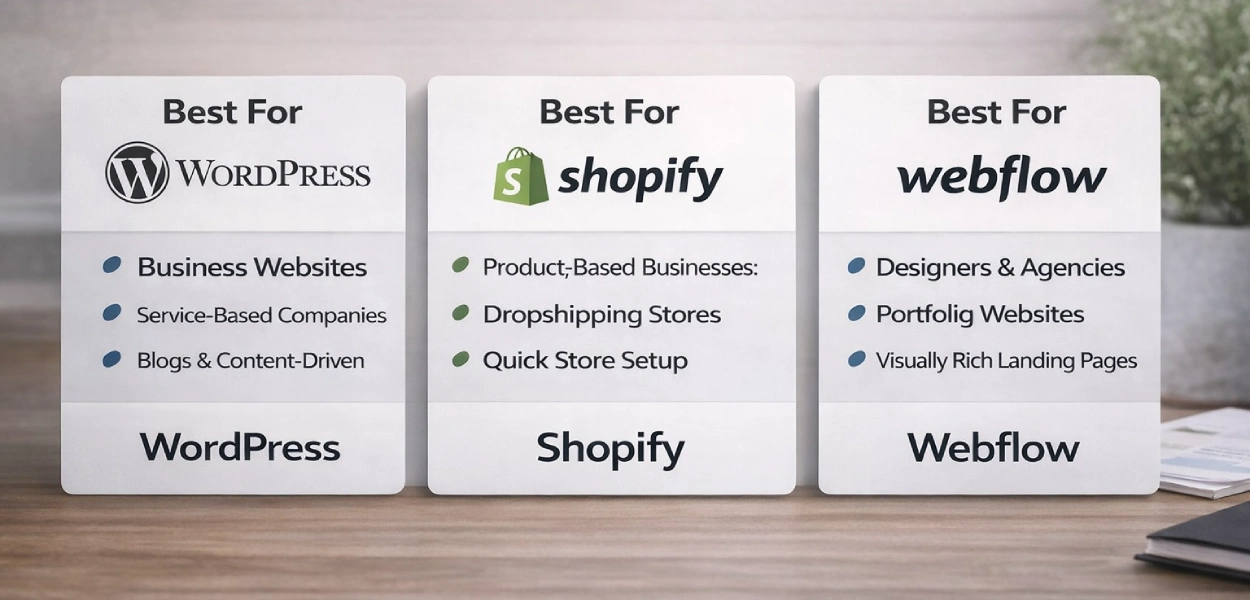
✅ Best For:
- Business websites
- Service-based companies
- Blogs & content-driven sites
- WooCommerce eCommerce stores
💡 Strengths:
- Complete design freedom (Elementor, custom builds)
- Highly scalable
- Thousands of plugins & integrations
- Full ownership of your website
⚠️ Considerations:
- Requires proper setup and maintenance
- Hosting and performance need to be managed well
👉 Verdict:
If you want control, flexibility, and long-term growth, WordPress is the strongest choice.
🛒 2. Shopify — Built for Selling
Shopify is designed specifically for eCommerce.
Everything is structured around selling products efficiently.
✅ Best For:
- Product-based businesses
- Dropshipping stores
- Quick store setup
💡 Strengths:
- Easy to set up and manage
- Built-in payment and checkout system
- Secure and reliable hosting
- Minimal technical knowledge required
⚠️ Limitations:
- Limited design flexibility compared to WordPress
- Monthly costs + transaction fees
- Less control over backend
👉 Verdict:
If your main focus is selling products quickly, Shopify is a solid option.
🎨 3. Webflow — Design Precision
Webflow is known for its design-first approach.
It gives designers full visual control without heavy coding.
✅ Best For:
- Designers & creative agencies
- Portfolio websites
- Visually rich landing pages
💡 Strengths:
- Pixel-perfect design control
- Clean, structured output
- Built-in hosting and CMS
⚠️ Limitations:
- Learning curve for non-designers
- Limited flexibility compared to WordPress
- Not ideal for complex websites or large-scale eCommerce
👉 Verdict:
If your priority is design precision and visual storytelling, Webflow stands out.
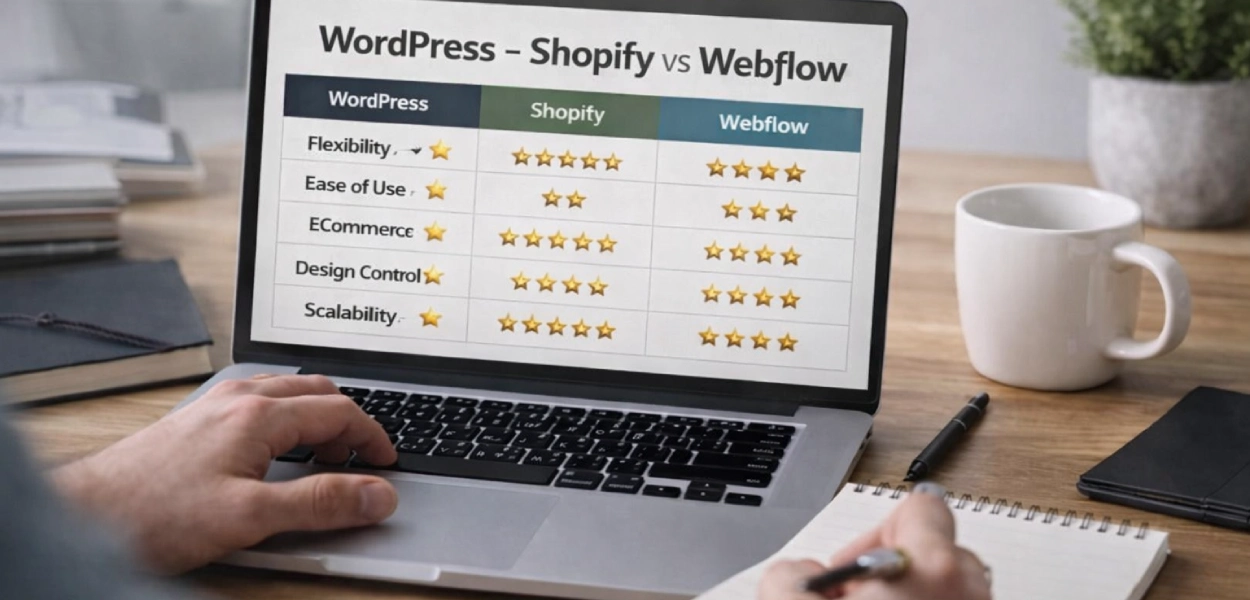
⚖️ 4. Quick Comparison
| Feature | WordPress | Shopify | Webflow |
|---|---|---|---|
| Flexibility | ⭐⭐⭐⭐⭐ | ⭐⭐ | ⭐⭐⭐ |
| Ease of Use | ⭐⭐⭐ | ⭐⭐⭐⭐ | ⭐⭐⭐ |
| eCommerce | ⭐⭐⭐⭐ (WooCommerce) | ⭐⭐⭐⭐⭐ | ⭐⭐ |
| Design Control | ⭐⭐⭐⭐ | ⭐⭐ | ⭐⭐⭐⭐⭐ |
| Scalability | ⭐⭐⭐⭐⭐ | ⭐⭐⭐ | ⭐⭐⭐ |
🧠 5. So… Which One Should You Choose?
👉 Choose WordPress if:
- You want a business website
- You need flexibility and scalability
- You want full ownership and control
👉 Choose Shopify if:
- You are focused purely on selling products
- You want a quick, ready-to-go store
- You prefer simplicity over flexibility
👉 Choose Webflow if:
- You care deeply about design aesthetics
- You want a visually unique website
- Your site is not too complex
🚀 The Real Insight Most People Miss
The platform itself is not the most important factor.
👉 The real difference comes from:
- how well the website is structured
- how clearly your services are presented
- how smoothly users can navigate
A poorly built website on the best platform will still fail.
A well-built website on the right platform will perform.
🏁 Final Thoughts
There is no “one-size-fits-all” answer.
- WordPress = flexibility & growth
- Shopify = simplicity & selling
- Webflow = design & control
👉 The right choice depends on your business goals—not trends.